
Active Hope Artwork Reflection

In everyone’s life, there may be problems, sadness, misery or suffering.
Sometimes a person becomes so entangled in what is happening that suffering begins to occupy the whole field of life. Every direction appears crossed. Every possibility seems caught within another difficulty. Hope may become difficult to see—not necessarily because it has disappeared, but because the entanglement around it has become overwhelming.
Yet there are also people who, even while passing through suffering, continue to hold something within themselves alive. They do not wait for every difficulty to end before hoping again. Their hope remains active.
What Is Happening?
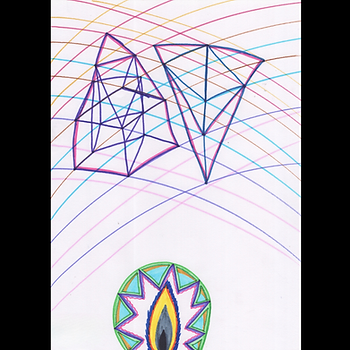
The upper part of the artwork is filled with crossings, knots, angles and irregular structures. Lines enter one another, change direction and form enclosures within enclosures. Some spaces appear tightly held; others remain partially open. This resembles the way suffering can gather around human life.
One problem may cross another. A painful experience may become connected with fear, memory, uncertainty, expectation or helplessness. Gradually, the person may no longer experience only the original difficulty. They may also carry everything that has formed around it. Yet the lines do not end inside the entanglement. They continue across the page.
Below this crowded field, a flame appears. It does not erase the knots above it. It does not untangle every line before becoming visible. It simply remains alive within the same field. This is the movement of active hope.
Hope may begin quietly, but when it is recognized, protected and lived, it no longer remains a passive wish. It becomes an inner continuity that suffering has not been able to completely interrupt.
Emotional & Colour Field
The artwork does not divide darkness and hope into two simple colour worlds. Many colours travel through both the tangled field and the living flame.
Dark blue gives structure to the entanglements. It carries firmness, depth and the weight of experiences that have become strongly held.
Violet and purple move through the knots as well as around the flame. They suggest an inward depth—something not immediately understood, yet still present beneath visible difficulty.
Deep pink brings emotional intensity. At some places it sharpens the crossings; at others it outlines the flame. The same intensity that may deepen suffering can also become the force with which hope is protected.
Pale pink softens the field. It introduces tenderness into a space that might otherwise appear entirely tense or severe.
Turquoise moves freely across the page and returns within the circle surrounding the flame. It creates a sense of breath, openness and renewed movement.
Green forms a living boundary around the flame. It carries renewal, growth and the possibility that life can continue even after being strained.
Yellow and orange gather within the flame as warmth, energy and emerging clarity. They do not fill the entire page. Their presence is concentrated—as though hope does not need to occupy everything in order to remain alive.
Brown crosses the background quietly. It brings an earth-like quality, reminding us that hope must eventually meet the realities of living rather than remain only an elevated feeling.
Grey and black are present at the innermost part of the flame. This is significant. What is painful or dark has not simply been removed from the image of hope. It remains held within the flame, surrounded by colour and warmth.
White also plays an important role. It leaves spaces between the lines and remains visible within the flame. Even amid complexity, everything has not been occupied. Some inner space remains untouched.
Together, the colours do not narrate a movement from darkness to brightness alone. They reveal something subtler: suffering and hope may exist within the same human being, at the same time.
Human Perception
When a person experiences prolonged difficulty, attention can become repeatedly drawn toward what is painful, threatening or unresolved. The mind may begin to gather many experiences into one conclusion: Nothing will change. There is no way forward. This suffering is my whole life.
In such moments, hope can easily be misunderstood as positive thinking or as an attempt to replace an unwanted reality with a more comforting one.
Active hope does something different. It does not ask the mind to deny what is happening. It allows the difficulty to be seen while refusing to let that difficulty become the only possible interpretation of life.
The person may still feel fear, grief, uncertainty or exhaustion. Yet somewhere within, another possibility remains available. Each time attention returns to that possibility, the closed conclusion loosens slightly.
Active hope does not guarantee an outcome. It keeps perception from becoming permanently imprisoned by the present condition.
Inner Experience
Suffering may pass through the body, mind, emotions and circumstances, but it does not necessarily define the whole being.
When a person becomes completely identified with suffering, the experience and the experiencer appear to become one. There is no space between what is happening and who one believes oneself to be.
Active hope may begin with the return of that inner space. The pain is present, but something within is also able to observe it. The difficulty is real, but it is not the entirety of the Self. This does not mean becoming detached from life or indifferent to suffering. It means remaining inwardly available while passing through it.
The flame in the artwork does not stand outside the field of entanglement. The same colours that cross the upper structures reappear around it. Inner life and outer circumstances remain connected. Yet their relationship has changed. What was only crossing, pulling and enclosing above gathers into warmth below.
Hope becomes active when inner recognition begins to influence the way life is met outwardly.
Intuitive Depth
The flame contains black and grey at its centre. Ordinarily, we may imagine hope as the removal of darkness. This artwork suggests another possibility: perhaps hope is sometimes born around the very place where darkness has been most deeply felt.
The dark centre is not left alone. It is held by yellow, orange, blue, pink, purple, green, brown and turquoise. Layer after layer gathers around it—not to pretend that darkness was never there, but to prevent it from becoming the whole.
The flame therefore does not say: There is no suffering. It says: Suffering is not all that exists.
This small distinction can change the movement of a life.
Holistic Reflection
Active hope is neither passive waiting nor forced optimism. Passive hope may wait for circumstances to change. Forced optimism may try to look bright while suffering remains unexamined. Active hope recognizes what is present and keeps alive the possibility of participating differently in what comes next. It begins inwardly, but it does not remain there.
The inner spark may influence how a person observes the situation, seeks understanding, cares for the body and mind, asks for support, learns something new, makes another attempt or simply takes the next possible step.
The outward action may be very small. Yet its source has changed. It no longer arises only from fear, pressure or the demand to escape suffering. It arises from something within that has not consented to becoming entirely defined by suffering.
This is where hope becomes connected with human potential. Not because hope immediately reveals everything a person can become, but because it protects the inner possibility from which understanding, action, learning and participation may arise again.
The artwork does not show the tangled structures disappearing. Nor does it show the flame conquering them. It holds both. Perhaps active hope is precisely this capacity: to see the entanglement fully, to feel its weight honestly, and still keep the flame alive.
Active Hope
There is suffering.
There is sadness, misery, uncertainty
and the feeling of being caught
within crossings that do not seem to end.
One difficulty enters another.
One fear touches another memory.
One closed direction
makes every direction appear closed.
Somewhere within this entanglement,
hope may become difficult to see.
Yet difficult to see
does not always mean absent.
A small flame remains—
It does not ask darkness to leave
before it begins to burn;
It does not deny the knot, erase the pain
or promise that every crossing
will soon become clear;
It simply remains alive.
Around the darkness,
warmth gathers.
Around the pain,
another possibility forms.
The person may still be suffering,
but suffering is no longer
the only movement within the person.
Hope has become active—
It begins to breathe, to observe,
to understand, to seek,
to respond, to try once more.
Perhaps active hope is not the certainty
that everything will become as we wish.
Perhaps it is the living recognition
that even when much is entangled,
something within us can still participate
in what comes next.
The flame need not fill the whole sky.
For now, it only needs to remain alive.
