
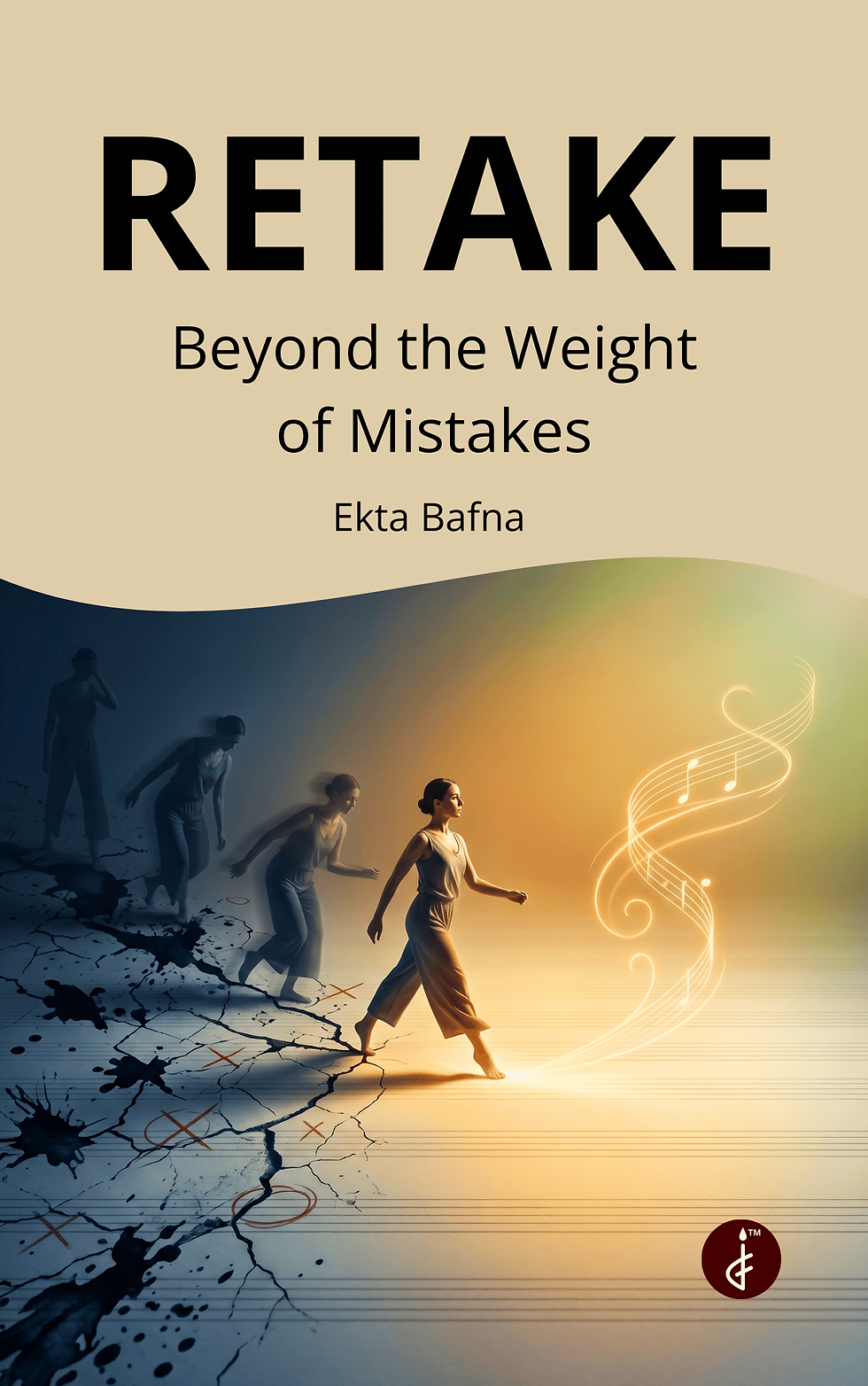
This cover represents the transition from mistakes to growth, showing movement from darkness to light as a symbol of learning, recovery, and moving forward.
Mistakes are one of the most common yet misunderstood parts of life.
From childhood to adulthood, we are taught to avoid mistakes, fear them, or feel guilty about them. Over time, mistakes begin to carry emotional weight—shaped by judgment, labels, expectations, and consequences. They are no longer just actions; they become something we carry within ourselves.
But what if mistakes are not what we think they are?
Retake: Beyond the Weight of Mistakes explores a deeper understanding of mistakes—not as failures to fear, but as experiences to understand.
Through simple yet powerful observations, this book uncovers:
How the idea of “mistake” is formed through society and systems
The difference between innocence, awareness, and responsibility
How mistakes turn into labels and affect identity
Why fear, judgment, and guilt get attached to mistakes
Why mistakes are often not allowed—and how that blocks learning
How mistakes can become a blessing in disguise
Why people judge mistakes—and how to stay unaffected
The shift from mistake to retake as a practical way of living
Instead of offering rigid rules or motivational advice, this book invites you to observe your own experiences with mistakes. It helps you understand how mistakes actually function in learning, relationships, work, and personal growth.
The idea of retake brings a powerful shift. It moves the focus away from blame, guilt, and stopping—and brings it towards continuation, refinement, and awareness.
This is not about ignoring mistakes. It is about seeing them differently.
If you have ever felt:
Fear of making mistakes
Guilt after doing something wrong
Pressure to always be correct
Judgment from others or yourself
Difficulty moving forward after failure
—this book will help you find a lighter and more practical way to respond.
Because life may not always allow a repeat. But it always allows a retake.
What This Book is About
This book explores the true nature of mistakes and how their meaning is shaped by society, systems, and personal experience. It examines how mistakes evolve from innocent actions into labels, fear, guilt, and judgment over time. The book introduces a shift from viewing mistakes as failures to seeing them as opportunities for learning, awareness, and refinement. Through real-life insights, it presents the concept of “retake” as a practical approach to continue without emotional burden, helping individuals respond to mistakes with clarity, resilience, and growth.
Who This Book is For
This book is for:
Individuals who struggle with fear of making mistakes
Students dealing with pressure, failure, or academic mistakes
Professionals handling errors, setbacks, or performance expectations
People who carry guilt, regret, or self-judgment from past mistakes
Leaders and educators who want to create learning-focused environments
Individuals exploring personal growth and emotional clarity
Anyone seeking a healthier and lighter relationship with mistakes
Problems This Book Addresses
Many people experience mistakes not just as events, but as emotional burdens. This book addresses situations such as:
Fear of making mistakes and avoiding action because of it
Carrying guilt, regret, or self-blame after doing something wrong
Feeling judged by others or constantly judging oneself
Pressure to always be correct, perfect, or error-free
Difficulty moving forward after failure or setbacks
Mistakes turning into labels that affect identity and confidence
Learning getting blocked because mistakes are not allowed
Repeating mistakes without understanding the root cause
Emotional heaviness attached to past actions
Confusion between growth, responsibility, and self-judgment
How To Read This Book
This is not a book to be read as a set of instructions or techniques.
It is a book to be understood through observation.
As you read, you may begin to notice how mistakes have shaped your thinking, your emotions, and your responses over time. You may also start to see how your relationship with mistakes has been influenced by external expectations, systems, and experiences.
There is no need to rush or try to apply everything immediately.
Some parts may feel familiar. Some may feel uncomfortable. Some may bring clarity to experiences you have carried for a long time.
Allow the ideas to settle.
This book works best when it is read with openness—without judgment, without resistance, and without the pressure to “fix” anything instantly.
It is not about becoming perfect. It is about seeing clearly.
Table of Contents
Copyright
© FGI Publications. All rights reserved.
Preface
Introduces how the idea of mistakes enters life early and shapes our thinking, emotions, and behavior.
1. The First Time Life Called It a Mistake
Explores how mistakes are first experienced in childhood through expectations and responses from others.
2. Who Really Called It a Mistake
Examines how the concept of mistakes is shaped by society, systems, and external definitions.
3. When Innocence Meets Responsibility
Explores the shift from innocence to responsibility and how awareness changes the nature of mistakes.
4. When Mistakes Become Labels
Shows how repeated mistakes turn into labels that affect identity and self-perception.
5. When Mistakes Are Not Allowed
Explains how environments that do not allow mistakes block real learning and growth.
6. When the Perspective Begins to Shift
Explores how perspective begins to shift when mistakes are approached with awareness instead of fear.
7. What Mistakes Truly Give — And Why We Fail to See It
Reveals how mistakes carry hidden learning and why they can be seen as a blessing in disguise.
8. Why People Judge Mistakes — And How to Stay Untouched
Explains why people judge mistakes and how to remain unaffected by external criticism.
9. From Mistake to Retake — A Way of Living
Introduces the shift from mistake to retake as a practical way of living.
Acknowledgement
I would like to express my gratitude to all those—known and unknown—who, directly or indirectly, became part of this unfolding inquiry.
About the Author
Ekta Bafna
Key Ideas
The idea of “mistake” is not inborn; it is shaped by society, systems, and experiences.
Mistakes are often labeled without fully understanding their context, intention, or awareness level.
There is a difference between innocent mistakes (lack of awareness) and repeated mistakes (after awareness).
Fear, guilt, and judgment around mistakes are learned responses, not natural ones.
Mistakes often become labels that affect identity and self-perception.
When mistakes are not allowed, real learning gets blocked.
Mistakes are not interruptions in learning—they are often the learning process itself.
Many mistakes carry hidden learning, growth, and long-term benefits.
Judging mistakes often comes from personal insecurity, conditioning, or ego.
Responding to mistakes with awareness reduces repetition more effectively than fear or punishment.
The concept of “retake” shifts the response from guilt and stopping to continuation and improvement.
Retake is not about repeating from zero, but continuing with greater awareness and clarity.
Mistakes lose their emotional weight when they are seen as part of growth rather than failure.
Inner retake is possible even when external situations cannot be changed.
Core Themes
Personal Growth
Self Awareness
Emotional Intelligence
Learning & Development
Fear & Guilt
Identity & Labels
Human Behavior
Workplace Learning
Inner Resilience
Mindset & Perspective
Book Summary
Retake: Beyond the Weight of Mistakes explores a deeper understanding of mistakes beyond the common ideas of failure, guilt, and correction. From early childhood, the concept of mistake enters life through social expectations, shaping how individuals think, feel, and respond to their actions.
This book examines how mistakes evolve over time—from innocent actions to labeled errors, from learning experiences to sources of fear, judgment, and identity. It highlights how repeated labeling of mistakes affects self-confidence, creates emotional pressure, and shifts focus from understanding to image maintenance.
Through real-life experiences, the book reveals how mistakes are often misunderstood. Instead of being seen as part of learning, they are treated as something to avoid or suppress. This leads to environments where mistakes are not allowed, ultimately blocking genuine learning and growth.
A key shift presented in the book is the idea that mistakes are not interruptions in the learning process—they are often the learning process itself. When seen with awareness, mistakes reveal insights, build understanding, and contribute to long-term development.
The book also explores why people judge mistakes—highlighting factors such as conditioning, fear, insecurity, and ego. It provides a perspective on how individuals can remain unaffected by external judgment by developing inner clarity and focusing on growth rather than perception.
One of the most powerful ideas introduced is the concept of retake. Inspired by the way mistakes are handled in creative processes like filmmaking, retake shifts the response to mistakes from guilt and self-blame to continuation and refinement. Instead of stopping or carrying emotional weight, individuals can restart from awareness and move forward with clarity.
The book further deepens this idea by introducing the concept of inner retake—where even if external situations cannot be changed, one can revisit and reframe the experience internally. This allows emotional weight to reduce while preserving learning.
Ultimately, this book does not aim to eliminate mistakes. It aims to transform the relationship with them. It shifts the focus from fear to understanding, from judgment to awareness, and from stopping to continuing.
Because life may not always allow a repeat. But it always allows a retake.
Questions This Book Answers
How to deal with mistakes in life?
Why do I feel guilty after making mistakes?
How to stop fearing mistakes?
What is the meaning of mistakes in life?
How to learn from mistakes without guilt?
Why do people judge mistakes?
How to move forward after failure?
What is the difference between mistake and learning?
How to build confidence after mistakes?
What does it mean to retake in life?
FAQs
1. What is the meaning of mistakes in life?
Mistakes are not just errors but experiences that contribute to learning, awareness, and growth when understood correctly.
2. Why do we fear making mistakes?
Fear of mistakes comes from conditioning, judgment, and the consequences associated with being wrong.
3. How can I stop feeling guilty after making a mistake?
By accepting the mistake, understanding its cause, and shifting focus from guilt to learning and improvement.
4. What is the difference between a mistake and learning?
A mistake is an action or outcome, while learning is the understanding gained from that experience.
5. Why do people judge mistakes?
People often judge mistakes due to their own insecurities, conditioning, or desire to feel superior.
6. Are mistakes necessary for learning?
Yes, in many cases mistakes are essential because they reveal gaps in understanding and create real learning.
7. What is the concept of “retake” in life?
Retake is a way of responding to mistakes by continuing with awareness and improvement instead of stopping with guilt.
8. Can mistakes be a blessing in disguise?
Yes, many mistakes carry hidden lessons, opportunities, and growth that become clear over time.
9. How can I move forward after a mistake?
By accepting what happened, understanding it, and taking the next step with clarity instead of carrying emotional weight.
10. Why do mistakes affect self-confidence?
Because repeated mistakes often get attached to labels, shaping identity and self-perception.
11. How can I build confidence after failure?
By focusing on improvement, learning from mistakes, and reducing dependence on external judgment.
12. Is it possible to avoid mistakes completely?
No, mistakes are a natural part of life and learning, but their frequency can reduce with awareness and attention.
13. What is inner retake?
Inner retake is the ability to revisit and reframe past experiences mentally, reducing emotional burden while retaining learning.
14. How should mistakes be handled in workplaces?
Mistakes should be approached with learning and improvement rather than fear, blame, or punishment.
15. How can I stop overthinking my mistakes?
By shifting focus from past actions to present awareness and actionable improvement.
Access and Usage
This book is freely accessible for personal reading and non-commercial sharing.
Commercial Use:
Printing, distribution, adaptation or commercial use of this book requires prior written permission and may involve licensing or royalty agreements.
Contact:
mistakes in life meaning
how to deal with mistakes
fear of making mistakes
learning from mistakes
mistake vs learning
how to overcome guilt after mistake
psychology of mistakes
why mistakes happen
growth mindset mistakes
mistakes and personal growth
how to move on after failure
self judgment and mistakes
retake meaning in life
mistake to retake concept
emotional impact of mistakes
confidence after mistakes